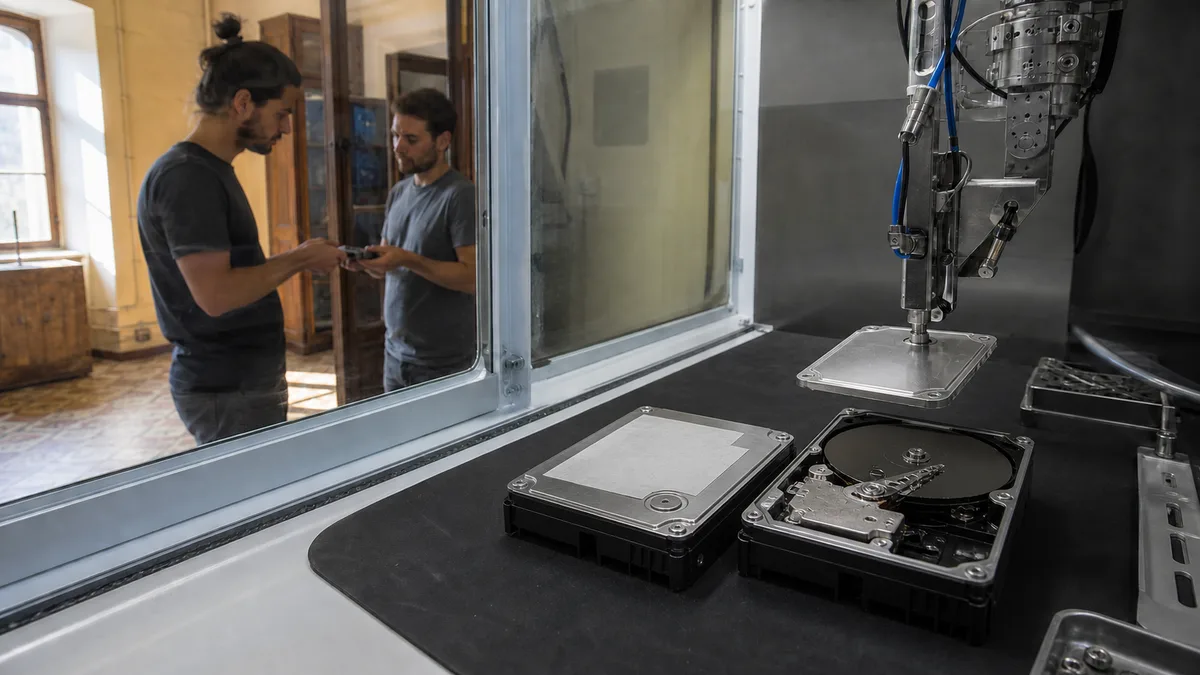
The short answer: You will not tell whether a drive is helium-filled from its capacity or from the suffix in its model designation. In the WD Red Plus product brief from March 2025 two 12 TB models sit side by side: WD120EFBX has the value Helium in the „Drive Technology" row, WD120EFGX the value Air. The helium unit is quieter and more economical, but it is hermetically sealed — the moment it is opened, the helium escapes for good. That is why doing it yourself, or improvising in a makeshift clean box, is ruled out with these drives.
A breather hole, or a hermetic enclosure
An ordinary air-filled drive is not a sealed box. It has a filtered breather hole with an explicit warning: „Do not cover, seal, or insert any object into this hole". According to the Seagate product manual the hole has two jobs — to let condensation inside the drive escape and to equalise pressure with the surroundings; covering or puncturing it endangers the reliability of the drive and voids the warranty (Barracuda 7200.7 Product Manual, sec. 3.2).
A helium drive has no such hole. Helium is sealed into the mechanism during manufacture and has to stay there; the internal environment is never exchanged with the surroundings. Toshiba describes the MG10 series as a „fourth-generation, 10-disk Helium-sealed design" — that is, a hermetically sealed mechanism with ten platters (Toshiba MG10 Series). That platter count applies to this particular series and nothing about other models can be derived from it.
The reason is physical: helium is less dense than air, so the spinning platters and the head arms meet less resistance. Sealing was historically the hardest part of the task — the Vienna laboratory Attingo recalls that in earlier attempts the drive could not be sealed tightly enough to keep the helium from escaping through permeation (Attingo).
Two 12 TB drives in the same series
The WD Red Plus series puts both technologies into a single product brief, into a single series and into the same capacity. I am adding a third column — the ten-terabyte WD101EFBX — because without it the wrong conclusion gets read out of the table.
| Parameter (product brief WD Red Plus, March 2025) | WD120EFBX — 12 TB | WD120EFGX — 12 TB | WD101EFBX — 10 TB |
|---|---|---|---|
| Drive Technology | Helium | Air | Air |
| Recording technology | CMR | CMR | CMR |
| Spin speed | 7200 | 7200 | 7200 |
| Interface | SATA 6 Gb/s | SATA 6 Gb/s | SATA 6 Gb/s |
| Cache | 256 MB | 512 MB | 256 MB |
| Internal transfer up to | 196 MB/s | 260 MB/s | 215 MB/s |
| Power draw read/write | 6.3 W | 8.8 W | 8.4 W |
| Power draw at idle | 2.9 W | 6.1 W | 4.6 W |
| Standby and sleep | 0.6 W | 0.3 W | 0.5 W |
| Noise at idle | 20 dBA | 34 dBA | 34 dBA |
| Noise during head seek (average) | 29 dBA | 39 dBA | 38 dBA |
| Shock while operating (2 ms, read/write) | 30 G | 70 G | 30 G |
| Shock while operating (2 ms, read) | 65 G | 70 G | 65 G |
| Shock non-operating (2 ms) | 300 G | 250 G | 250 G |
| Weight | 0.66 kg | 0.75 kg | 0.75 kg |
Source of all values: product brief WD Red Plus. Common to the whole series are a workload of 180 TB per year, an MTBF of 1,000,000 hours, 600,000 load/unload cycles, fewer than one non-recoverable error per 10^14 bits read, a three-year limited warranty and an operating temperature of 0 to 65 °C.
Three things follow from the table that are commonly said the other way round.
Capacity does not decide the technology. Both 12 TB models are the same size and one of them is air-filled. Claims of the „everything from twelve terabytes upwards is helium" kind are refuted by this single row. Anyone who needs certainty has to go into the product brief of the specific model.
Helium is paid for in transfer speed. The air-filled 12 TB has the larger cache and the higher declared internal transfer rate. The helium one runs at idle on barely half the power draw and is fourteen decibels quieter — which is why it ends up in enclosures that stand in an office.
Lower shock tolerance is not a property of helium. The helium 12 TB withstands 30 G while operating against seventy for the air-filled one — except that the air-filled WD101EFBX also has 30 G in the very same row. That value therefore belongs to the given mechanical platform, not to the gas inside. The practical impact stays the same and is worth remembering: on models rated at thirty G, a knock against a running NAS means a substantially greater risk than on models rated at seventy. Which of your drives you have is something you find out in the table, not by estimating.
The buying view of this segment is covered by the comparison of WD Red, IronWolf and N300, the recording technology by the overview of CMR and SMR. This article is about the gas inside and about what it means for data recovery.
How to find out whether your drive is helium-filled
The model designation is not enough. WD120EFBX is helium-filled, but WD101EFBX with the same EFBX suffix is air-filled. The suffix in the SKU does not encode the technology here.
Only the product brief of the specific model gives the answer. The procedure is boring and it works: copy out the complete model designation from the label, find the manufacturer’s product brief and read the „Drive Technology" row.
SMART gives an indication, not proof. The database of the smartmontools project has, by default, attribute 22 named Helium_Level with the note „WDC (HGST)". Toshiba uses two attributes for the same thing, 23 Helium_Condition_Lower and 24 Helium_Condition_Upper, and on helium Seagate drives attribute 200 has the meaning „Pressure_Limit" instead of the usual Multi_Zone_Error_Rate (drivedb.h). You can list them with the command smartctl -A /dev/sda.
What that value means was tracked down by Backblaze directly with the manufacturer: attribute 22 is the state of the helium inside the drive, it is a pre-fail attribute and it trips at the moment the drive determines that its internal environment is out of specification; for the tested HGST Ultrastar He8 drives a normalised threshold of 25 was given (Backblaze).
Beware of reading it in reverse: a missing attribute 22 is no proof that a drive is not helium-filled. Older versions of smartctl displayed it as Unknown_Attribute, and the smartmontools database notes directly, for the white-label WD drives of the He10/He12 series, that the WD80EDAZ and WD40EDAZ models do not report it.
Why a helium drive is opened only in a laboratory
Opening the drive is a one-way operation on a helium mechanism. The PITS laboratory describes it like this for the Seagate Exos X18: the drive cannot be opened outside a professional ISO certified clean room, opening it lets the helium escape irreversibly and the internal environment changes at once — the resistance of the medium, the friction of the platter and the temperature all go up. After opening, they say, the drive works for only a very short window, on the order of hours or less, and after a head stack replacement read errors kept accumulating for them, because the internal balance of the mechanism had changed (PITS).
Two things follow from this for the owner of a NAS. The option of „I will open it at home or in an improvised box and see" is gone — on an air-filled drive it is a bad idea, on a helium one it is irreversible. And gone too is the notion that the work can be spread over several attempts on different days: the read has to be prepared as a single run, including the destination storage and the order of the folders. That refilling the gas is reckoned with on helium drives is confirmed by Attingo — pressure cylinders are part of the standard equipment in their laboratories and they have been developing the method for helium drives since 2014. What the procedure will look like for your particular unit is decided only by the initial diagnosis.
Working with an open mechanism is otherwise the same as with air-filled drives: replacing crashed read/write heads and assessing microscoring on the platter. There is just less time for it and fewer attempts.
When a helium drive fails in an array
The procedure is the same as with other drives, only with a smaller margin for error.
- Do not try it again. Repeated power-ons are the riskiest thing on a drive with a mechanical fault — every further spin-up is an opportunity to damage the surface.
- Do not rebuild blindly. Until it is clear why the drive dropped out, a rebuild only adds a full read load onto the remaining drives (Why a rebuild kills a RAID array).
- Write down the order of the drives in the slots and do not swap the drives around. Without the order, the array is harder to reassemble.
- Do not run file system repair tools over the original and do not confirm initialisation or formatting of the volume.
- Get the data out of the array while it is still readable, and only then deal with the hardware — the safe procedure for a NAS.
Where to put a helium drive in a NAS
Lower shock tolerance can be designed around entirely. The enclosure belongs on a firm base, not on the floor by a door or under a desk where it gets kicked; drives are not swapped and the enclosure is not moved while it is running. And because quiet operation tends to be the main reason helium models end up in an office, watch that the saving in noise does not come at the expense of airflow.
If you are not sure about the drive selection, the placement or the cooling, we do the design and management of a company NAS as a routine service — including a check of which drives are actually in the array. If the drive has already failed, it starts with diagnostics: data recovery with us starts with an assessment of the condition and an estimate, not by opening the mechanism. Write or call via contact and add the information about the array type and the slot order.
Frequently asked questions
Are all high-capacity drives helium-filled?
No. The WD Red Plus series has, in the same 12 TB capacity, the helium model WD120EFBX as well as the air-filled WD120EFGX. Capacity by itself does not determine the technology — the product brief of the specific model decides.
Can a helium drive be recognised from the label?
Not reliably. On the label there is the model designation, and that is the input, not the answer: with it you go to the manufacturer’s product brief and look for the „Drive Technology" row.
Is a helium drive more failure-prone than an air-filled one?
That does not follow from the WD Red Plus product brief — both 12 TB models have the same workload of 180 TB per year, the same MTBF of 1,000,000 hours and the same three-year warranty. What differs is noise, power draw, transfer speed and declared shock tolerance.
What does attribute 22 in SMART mean?
On WDC and HGST drives it is the state of the helium inside the mechanism. It is a pre-fail attribute that trips as soon as the drive evaluates the internal environment as out of specification. Toshiba uses attributes 23 and 24, helium Seagate drives attribute 200.
Where to find us
ITHOPE is a company based in Brno, Czechia: we do data recovery from disks, RAID and NAS, PC and laptop service and IT for business, all in our own lab at Viniční 3587/216, 615 00 Brno.
Phone +420 775 556 063 (24/7 line). You can bring the device in person, or send it by courier (Zásilkovna, PPL).