Quick summary
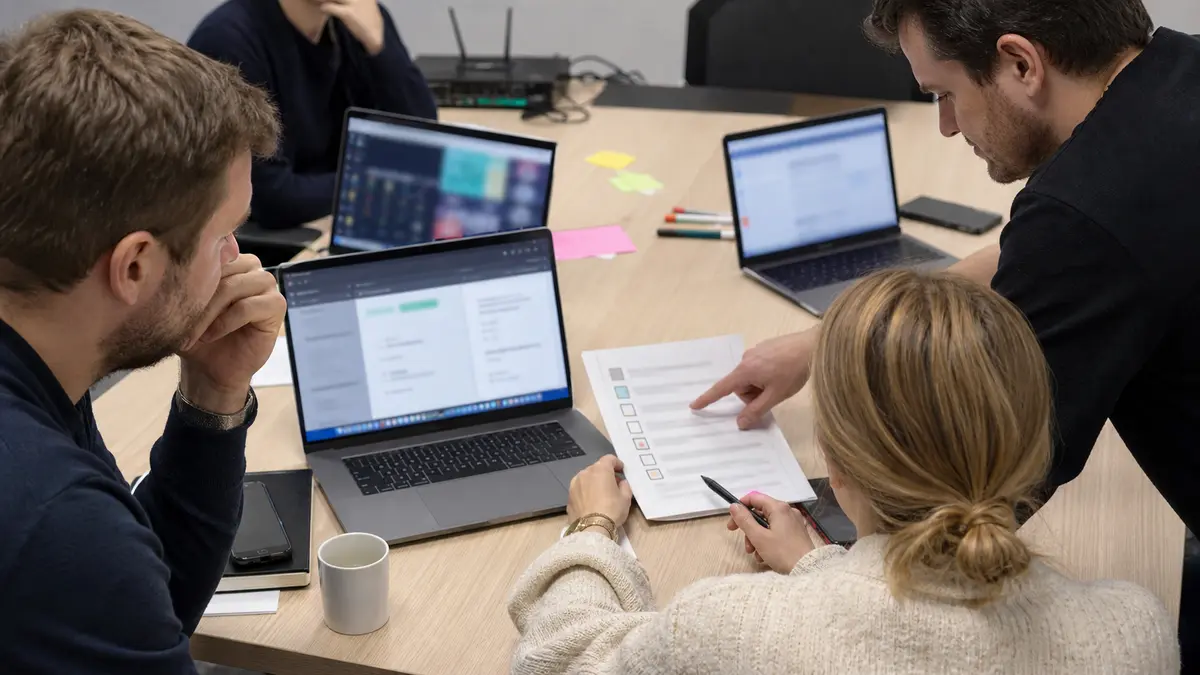
Good AI training for businesses is not a lecture about the future. It is a hands-on workshop where the team, working on their own tasks, learns when AI helps, when it makes things up, and how to handle it safely. People walk away not just with inspiration, but with practices they can use the very next working day.
- For management — what pays off, where the risks are, how to set responsibility, and first steps without chaos.
- For employees — prompts, output verification, working with documents, spreadsheets, e-mails, and meetings.
- For technical teams — workflows, automation, local AI, RAG, and integration with internal systems.
- For the whole company — simple rules on what belongs in AI, what is sensitive, and who approves the outputs.
Why book the training
Your people are probably already using AI. Some safely, some clumsily, some perhaps copying sensitive details into a tool the company does not even know about. Banning AI usually does not work. It is better to give the team clear rules, show good practices, and explain when AI should save time and when a person should pay attention.
After practical training, AI stops being a toy for a few enthusiasts and becomes a shared working tool. Sales know how to prepare a draft reply. Administration can process a longer document without reading it paragraph by paragraph. Management has an overview of where AI helps and where a local or controlled model is needed. IT knows which rules to watch.
What the team takes away
- A set of usable prompts for your typical tasks, not universal phrases from a presentation.
- A checklist for safe AI use: what may go into AI, what must not, and what a person must check.
- Procedures for checking outputs: how to spot a hallucination, an inaccuracy, a bad source, or an overconfident answer.
- Ideas for first automations: processes where it pays to add a workflow, RAG, or an internal assistant.
- A shared language for the company: so that management, employees, and IT talk about AI the same way, not each according to a different video from the internet.
What the team will learn
This is not more general talk about AI that fades in a week. We build the training around your real tasks, spreadsheets, and processes. Safely, locally, and with a clear practical outcome.
Prompts and effective work with AI
Writing prompts is not magic, but a craft. We teach you to structure queries so that AI delivers reusable results — from summarising meetings to analysing contracts. We show advanced techniques that give you consistent outputs without endless manual fine-tuning.
Verifying outputs and critical reading
Text that sounds convincing does not yet mean it is correct. We explain how to recognise typical hallucinations, logical errors, and superficial answers. You get a practical framework for fact-checking and learn to hold a dialogue with AI that sharpens outputs instead of watering them down.
AI and GDPR — what may and may not go into AI
Do not expect legal training, but a practical signpost. We go through which company information can be entered into AI and what may already pose a risk. We show how to set internal rules so you can more easily demonstrate compliance — especially with tools whose servers may not run in the EU.
A first automation on your real processes
The most popular part. We take a specific routine from your company — approving orders, recording enquiries, preparing materials — and during the training teach the team to develop it into an automated flow. AI prepares, a person approves, the system sends. Usable practically straight away.
Who the training is for
For management, who need to understand the possibilities and limits of AI before approving tools across the company. For specialists who want to work with AI more efficiently and safely. For teams where ideas for improvement are born right in the operation. We tailor the level — from the basics for beginners to advanced workflows for technical teams. We tune the content to your field, not to our template.
Management and company owners
You need to know what pays off, where the risks are, and how to set responsibility. We go through the choice between cloud and local AI, working with sensitive data, costs, and realistic steps for a first pilot.
Administration, sales, and customer care
Teams try out drafting replies, summarising documents, working with spreadsheets, preparing materials, checking for errors, and procedures for repetitive tasks. The emphasis is on outputs they will use the very next working day.
IT and technical specialists
For technical teams we go deeper: local models, RAG, automation via n8n or Make, API integration, permissions, logging, and operational limits.
How the training works
No practice files, no artificial data. We work with your real materials — e-mails, spreadsheets, texts you know. Instead of theory, you immediately tackle tasks you would be doing anyway, just faster and smarter. The training takes place at your premises, in our lab in Brno-Židenice, or online.
Before the workshop we ask you for a few typical tasks: an e-mail, a document, a spreadsheet, an enquiry, meeting notes, or an internal process. We prepare the scenarios accordingly. As a result, the training does not feel like an outside course, but like work on your own operation.
Afterwards we can smoothly move on to implementation and automation — if you wish, you leave not only with knowledge, but with a concrete path to a first deployment.
Training outcomes
After the training, the team has a shared language and basic rules for working with AI. Depending on the agreed scope, you get a checklist for safe AI use, sample prompts for your processes, a list of suitable and unsuitable data, automation proposals, and a recommendation on where it makes sense to continue with AI deployment or a standalone pilot.
Why ITHOPE
- We are not presentation trainers — we actually deploy, operate, and integrate AI into company systems. We teach the practices we use in our work.
- We know security and data — we handle IT management, backups, servers, cybersecurity, and data recovery. That is why in training we do not ignore GDPR, permissions, and the risk of know-how leaking.
- We have our own infrastructure — when it turns out the public cloud is not enough for your data, we can follow up with local AI or a controlled environment.
- We understand non-technical teams — we tailor the training to salespeople, administration, management, and technicians. Each needs different examples.
- We can follow up with delivery — when during the workshop we discover a process worth automating, you do not have to look for another supplier. We can take it straight into a pilot.
From training to a first deployment
Training is the beginning, not the end. During the workshop we often discover processes that can be automated within the same week. We have the capacity and know-how to take over AI deployment — from internal assistants to automating routine administration.
Send us the department you want to train and 2 to 3 typical tasks it handles every week. We will design the workshop so that people do not leave merely with the impression that AI is interesting, but with concrete procedures for their work. We work in Brno but travel to companies across Czechia.
Related services: AI for business, process automation, and IT for business.