Quick summary
Process automation has the highest return where people repeatedly rewrite data, watch deadlines, sort requests, or assemble reports from several systems. We do not start with a big transformation. We find one annoying process, build a pilot, and verify whether it saves time, reduces errors, or speeds up the response to a customer.
- n8n, Make, and API integrations — connecting e-mail, CRM, ERP, e-shop, warehouse, accounting, or helpdesk.
- AI steps in the process — understanding text, drafting replies, classifying requests, or extracting data from documents.
- Local operation according to data sensitivity — for sensitive workflows we can choose local tools and our own infrastructure.
- A measurable pilot — we agree in advance on how we will know the automation makes economic sense.
What changes in your company
An enquiry no longer sits in someone’s e-mail because they forgot to forward it. An invoice is not lost among attachments. A report is not assembled by hand from five exports on a Friday afternoon. A salesperson sees a new lead in the CRM, the accountant handles the exceptions, and the manager has an overview of where the process stands.
Good automation is not about „a robot doing everything by itself". It is about ordinary steps running reliably, risky steps waiting for approval, and every important action leaving a trace. People then handle decisions, customers, and exceptions, not routine.
Where automation pays back quickly
The fastest return usually comes from activities that repeat every day or every week: rewriting data, checking attachments, manually creating tickets, watching deadlines, exports and imports, drafting replies, or regular reporting. It is often not one big mistake, but dozens of small delays that add up to entire working days over a month.
That is why we start with a process map and a simple question: where does a person today do work that a system could prepare, check, or pass on?
What we automate
Automation makes sense wherever routine activities repeat according to clear rules. Typically these are tasks that take hours from your people yet require no creative judgement. The areas where we help most often:
Invoices and documents
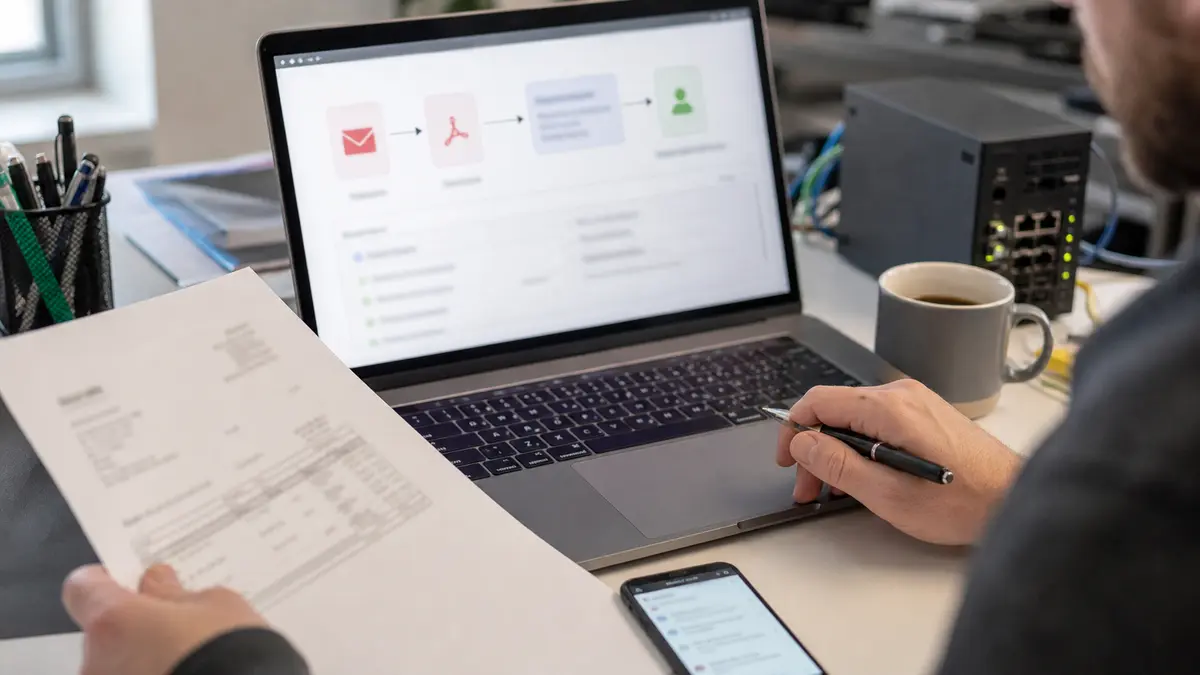
An incoming invoice lands in the inbox, and the person’s work ends there. The system extracts it on its own using OCR, checks the details with AI, and records it in the accounting system. The person only gets to the exceptions — when amounts do not match, say, or a mandatory field is missing. Accountants can focus on checks and analysis instead of rewriting.
E-mails and communication
Not everything has to be sorted by an assistant. Automation recognises the type of request, separates the urgent from the newsletters, and for standard queries prepares a draft reply. You check the AI draft, adjust it if needed — and send it. The message does not get lost, and you keep control over what leaves the company.
Documents and data
Extracting data from PDFs, transferring meeting notes into the CRM, pulling key details from contracts. Automation extracts structured data from unstructured materials and passes it into the systems where you work with it further. You do not have to copy anything between windows.
Reporting and watchdogs
A regular report on stock levels, a watchdog for due dates, a notification about an unusual drop in margin. The system compiles the data, formats it, and sends it at a set time. You check whether the numbers make sense — and deal only with the deviations.
Connecting systems
E-shop, ERP, CRM, helpdesk — systems that often talk to each other minimally. We build bridges via API or using platforms like n8n and Make so that they exchange data without manual export and import. A new order writes itself into invoicing, the warehouse, and the salesperson’s notes.
Processes we typically handle
Administration and back office
Incoming documents, orders, contracts, requests, approvals, and deadline reminders. This is where small mistakes with a big impact often arise: a forgotten e-mail, a manually retyped number, a request created too late. A workflow can record, pass on, and check every step.
Sales and customer care
A new lead is automatically created in the CRM, gets the right priority, and the salesperson has materials ready to respond. For existing customers, you can keep track of contract renewals, open requests, or regular follow-ups. AI can prepare a draft reply, but sending it stays with a person.
Service and operations
Automation helps with planning service call-outs, sorting tickets, handing materials to a technician, and recording completed work. If you already have a helpdesk or internal system, we connect to it; when one is missing, we propose a simple flow without unnecessary overhead.
When automation pays off — and when it does not
Automation is not a universal answer to every operational problem. It pays off when a process repeats at least a few times a week, has clear rules, and exceptions make up a minority of cases. The ideal candidate: regular tasks where errors arise from fatigue and rewriting.
By contrast, it makes no sense for one-off actions or for processes that change constantly. If the brief differs every time and requires individual judgement from start to finish, the cost of automation will not come back. The same goes for activities that take a few minutes a month — the time saved would be smaller than the maintenance overhead.
We say it straight: sometimes it is better to leave things as they are. But when it fits, it pays back quickly. We discuss what really pays off in more detail in the article Process automation in a company with AI.
How it works
Process audit
We sit down over your operations and identify the processes worth automating. We look at frequency, how rule-based they are, and the potential impact. The outcome is a short recommendation: what to tackle first and why.
A pilot of one process
We do not like to talk about „transformation" — we start with one specific process. We build a working prototype, tune it on real data, and verify that it delivers the expected effect. Only then do we move on.
Deployment and operation
After tuning, we put it into live operation. What matters is that you are not left alone with it — we provide support, monitoring, and gradually extend the automation to further processes. Everything runs under our management, while you handle your business.
What we never release without control
Automation must not be a black box that starts sending out wrong invoices or replies to customers on its own. For sensitive steps we set up approval: AI or the workflow prepares a draft, a person verifies the result, and only then does the system continue. We log important actions so that it can later be traced what happened and why.
Why ITHOPE
- We see both the process and the infrastructure — automation often fails not on the idea, but on connecting systems, permissions, data, and operations. These are things we routinely handle at companies.
- We can run it locally and securely — when a workflow works with sensitive data, it does not have to run through an anonymous cloud. We design the model according to GDPR, the risks, and your systems.
- One partner, one responsibility — you do not handle automation separately, IT management separately, and security with a third party. We keep everything under one roof, so when something does not work, you know who to call.
- We build and operate — we design and implement the automation and, above all, look after it over the long term. A workflow is a living thing; processes change and integrations need to be maintained.
- We do not automate at any cost — when it is cheaper to change a procedure, adjust a form, or use an off-the-shelf tool, we say so. Automation should earn time, not create more overhead.
We often combine automation with AI deployment — where fixed rules are not enough and there is a need to understand text or documents.
Start with one process
No big transformation, no revolutionary roadmaps. We start with one annoying process that holds you up every day: invoices someone rewrites; reports that get forgotten; orders that are manually flipped between systems; e-mails waiting for the right person.
Send us one process that bothers you. We will go through it, tell you whether automation makes sense, and propose the smallest pilot on which the return can be verified.
Related services: AI for business, custom application development, and IT for business.