The situation
The drive arrived in a box by courier. The accompanying letter had a single line: „It’s already been through another shop. Now we really need this."
It was a WD WD10JPVX 1 TB 2.5” — a standard laptop drive from 2013. The problem: someone at the previous shop had opened the drive, evidently without a dust-free environment.
For the B2B client, this was critical technical data from two years of project documentation. No backup outside this one drive.
Diagnostics
The visual inspection after intake was unpleasant:
- The cover screws were backed out, some could not be tightened (stripped threads).
- The cover sat crooked — you could tell someone had tried to fit the cover and then remove it again.
- The seal around the cover was breached. The air-filtration labyrinth was clogged with dust from outside.
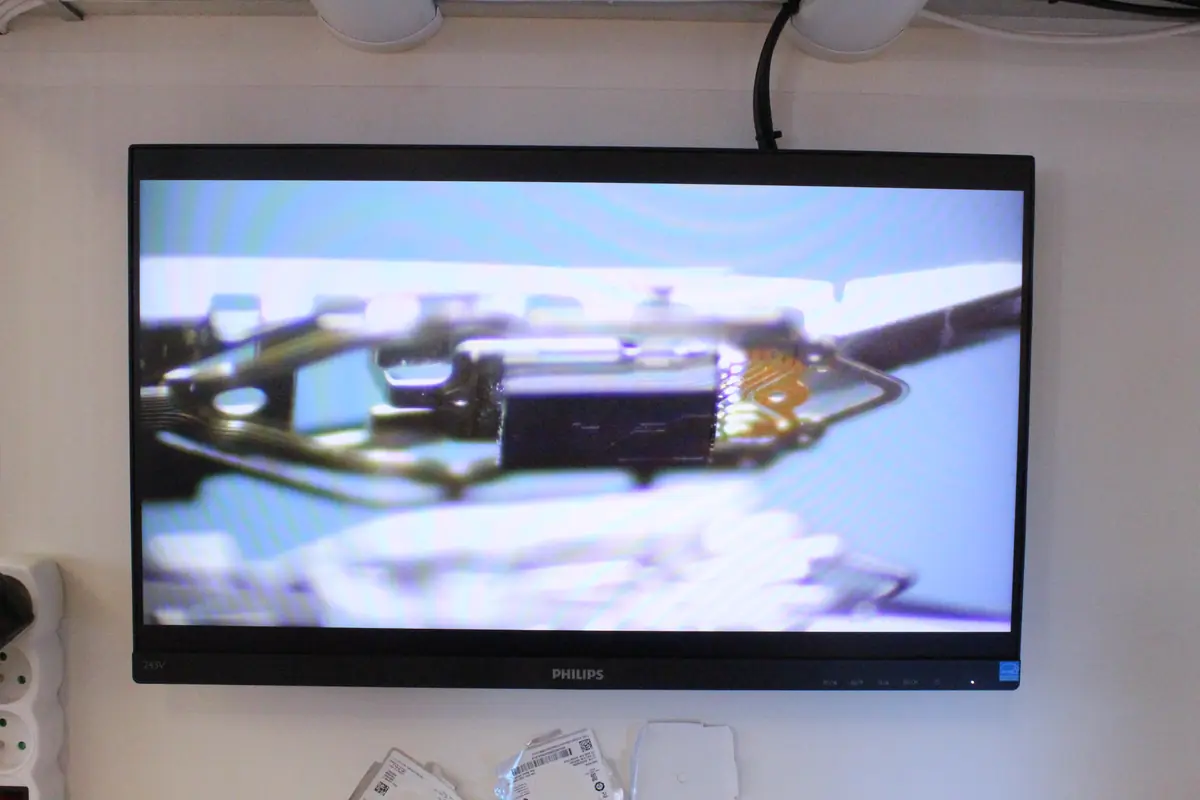
Under the electron microscope in the clean room:
- Data surfaces contaminated — dust particles in several areas. 80 % of it on tracks in the frequent-write zone.
- Head stack assembly mechanically defective — the arms had been bent by someone, the head 1 slider no longer flies smoothly over the platter.
- Parking ramp undamaged — the one piece of good news, the drive can be safely spun down and spun up.
The previous shop’s technician probably refitted the heads „by eye" and tried to plug the drive straight into Windows. The result was a rotation cycle of another few seconds, during which dust particles under the head could scrape away more data.
The solution
Nine days in total — a fast turnaround thanks to the clear diagnosis:
- Day 1: Intake from the B2B partner via courier, visual inspection, microscope, X-ray check of the integrity of the motor and bearings.
- Days 2–3: Full cleaning in the clean chamber. The data surfaces went through several cleaning cycles — isopropanol + special lint-free wipes + vacuum extraction of loose particles. Room size 10 m³, filtration of 100 particles 0.5 μm/cubic foot.
- Day 4: Donor search. The WD WD10JPVX 2013 has several firmware revisions; it’s important to have a matching version. We found one in stock, manufacturing year within ±6 months.
- Day 5: Transplant of the head stack assembly from the donor. Precision work — the heads must be exactly in position for the parking ramp, no force, the whole operation in the clean room.
- Days 6–7: Imaging via DeepSpar Disk Imager. An aggressive strategy for the defective sectors — the drive stalled in two places where the contamination was worst. A total of 9 % of sectors were unread.
- Day 8: NTFS reconstruction from the clone, the MFT intact, the file system reconstructed without the need for manual recovery.
- Day 9: Check of the recovered data, export via the B2B partner to the client. 91 % of files fine with no errors, 4 % damaged JPG/PDF, 5 % missing.
The result
- 91 % of data recovered (about 560 GB out of 620 GB of used capacity)
- 9 days in total
- The project documentation was preserved in full. Only old invoice backups were missing, which the client still had in their accounting system.
- The B2B partner received a standard report and invoice; the client took over the data.
Lessons learned
Once a drive is open, time matters. Every hour it lies in dust worsens the odds. Every additional power-up means the risk that a particle between the head and the platter takes more data with it.
A few rules for those who nonetheless refused to give up on do-it-yourself:
- Once you’ve opened the drive, close it immediately and take it to a shop with a clean chamber. Do not try to „straighten" the heads.
- Do not open the drive in an environment where people, cats or dust are moving around. A kitchen, living room or garage is a gamble.
- If a company offers „data recovery" and has no clean room, ask specifically where they open drives. If you don’t get a clear answer, look elsewhere.
For B2B partners — this is exactly why you send the valuable cases to us. We have a class 100 clean room, microscopes, stock drives for transplants and instruments for sector extraction. A garage cannot replace that.
What to watch out for
When a B2B client claims that „the drive has already been to another specialist," it’s worth asking specifically: where, how long it was open, in what environment. These 30 seconds of questions often save us days of work — and you false hopes.
Have a similar case? HDD recovery enquiry · +420 775 556 063 · B2B partner portal