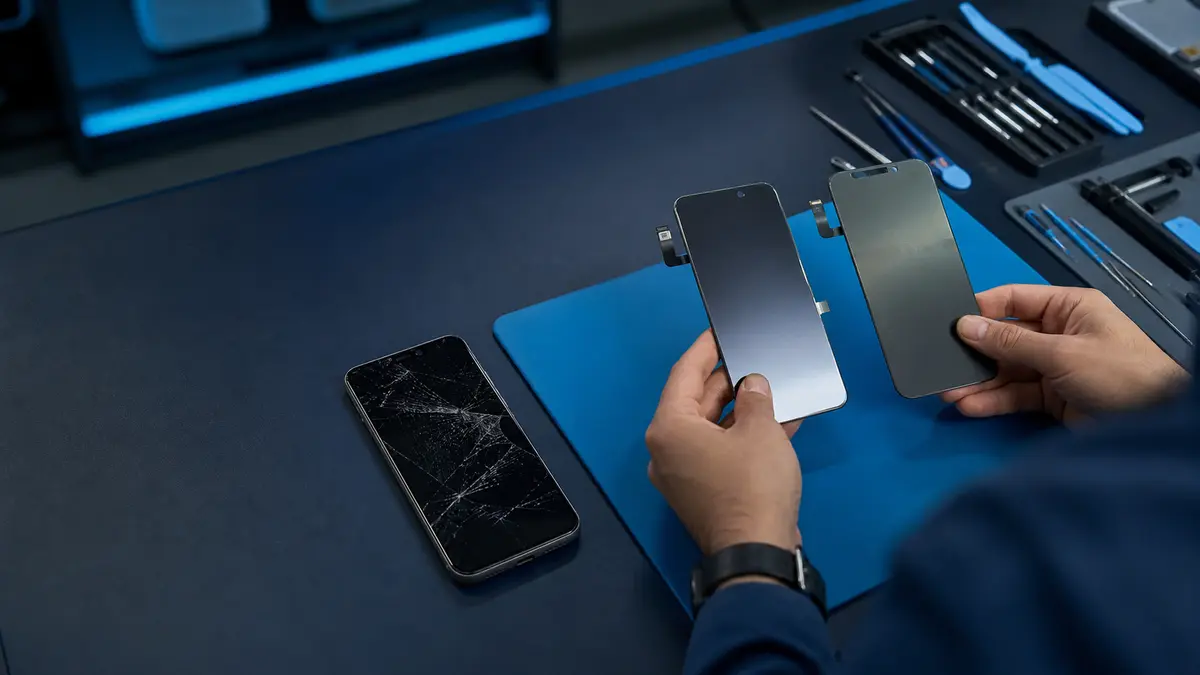
The short answer: There is no single price for „an iPhone screen" — the panels for an iPhone 12 mini and an iPhone 15 Pro Max are entirely different parts, and the difference between a genuine part and a copy is not just the price, but also what the phone displays in Settings after the repair. The key point when comparing quotes is this: since iOS 18, an independent repair provider can finish and calibrate a genuine part directly on the phone (using Repair Assistant on iPhone 12 and later), while an aftermarket panel remains listed as an „Unknown Part" in Parts and Service History. We can therefore provide an initial price based on the model and part type, but confirm the final price only after inspecting the phone — and every quote always states which part it includes.
Why the final price is confirmed only after inspecting the phone
The question „how much does an iPhone screen replacement cost?" does not include any of the information that determines the price. Once you specify the model and the type of part, a repair provider can give you an estimate or a fixed price — subject to any additional faults discovered when the phone is opened. Screen assemblies vary enormously between models: a 5.4-inch OLED for an iPhone 12 mini is a different part from a 6.7-inch LTPO panel with ProMotion for a Pro Max. Even before the choice of part comes into play, the phone’s condition matters.
What the diagnostic inspection looks for:
- the exact model (not simply „a fourteen," but 14, 14 Plus, 14 Pro, or 14 Pro Max — these use four different panels),
- whether only the glass or the panel itself is damaged: cracked glass with a readable image and working touch input is a different situation from a black screen, a green or pink line, or an area of the screen that does not respond to touch,
- the condition of the frame: iPhones from the 12 onward have flat edges, and a frame bent by a fall onto a corner is harder to spot than on a rounded body — a new panel will not seat properly in a warped frame, may crack again, and cannot be sealed correctly,
- the damage history: drops, water exposure, or heating up after an impact,
- related faults: the earpiece, front camera, sensors beneath the top edge, and buttons.
There is one more point that should be stated honestly in advance: opening the phone ends the manufacturer’s original declared water resistance. The IP68 rating applies to the model as it left the factory, not to an individual device after repair. We install a new adhesive seal, and a service pressure test can be performed, but neither restores the original declared level of resistance on its own. We therefore do not provide a warranty against liquid ingress after repair — and it is sensible to ask about this in every quote.
What has changed on the iPhone: parts pairing and Repair Assistant
Since the iPhone 12, the phone has kept a record of replaced components. You can find it in Settings → General → About, under Parts and Service History near the bottom. Apple tracks the screen, battery, cameras, logic board, and other components there, showing whether each component is a genuine Apple part and whether the repair was properly completed.
A major change arrived in autumn 2024 with iOS 18 and Repair Assistant (called „Průvodce opravami" in Apple’s Czech documentation). A genuine part can now be calibrated and the repair completed directly on the phone — the device does not need to be sent to an authorized centre, and an authorized repair provider does not need to take part in the process. It is not a purely local operation, however: after the part is installed, the assistant appears in Settings and requires an unlocked phone, an internet connection, and verification of the part against Apple’s systems.
This creates a distinction that is often overlooked when comparing quotes — the individual statuses in Parts and Service History are different and must be interpreted separately:
- genuine part with a completed repair — the phone identifies it as a genuine Apple part; a part transferred from another device may also be marked as used,
- unfinished repair — for a supported component, the phone offers to finish the process („Finish Repair"), and the record remains incomplete until the assistant has run,
- unknown part — the phone could not verify the component. This typically means an aftermarket panel, but there are other possible causes: a damaged or faulty connection, a part from another device that has not been verified, or an older version of iOS. An „Unknown Part" message therefore does not automatically mean the part is a copy.
Simply asking „is it genuine?" is therefore not enough. The real question is: is it genuine, and will you finish the repair with Repair Assistant so that the phone records the part as verified?
Three repair routes, not three types of screen
An AASP (Apple Authorized Service Provider) is not a third type of panel. It is a repair route. The comparison therefore looks like this:
| Option | Part you receive | Repair completion | What the phone shows | When to choose it |
|---|---|---|---|---|
| Independent repair provider + genuine part | Genuine Apple part from a distribution programme | Calibration on the phone with Repair Assistant (iPhone 12 and later, iOS 18+) | Genuine Apple part, repair completed | An out-of-warranty repair when you want a genuine part and a clean service history |
| Independent repair provider + aftermarket part | Compatible panel made by another manufacturer | Cannot be completed as a genuine-part repair | „Unknown Part" in Parts and Service History + a notification after repair | When you know the panel type, accept the record, and the price is appropriate for the phone’s residual value |
| Apple or AASP | Genuine part installed through an authorized process | Completed by the authorized repair provider | Genuine part, completed repair, authorized service documentation | Warranty claims, insurance claims, or a company policy requiring authorized service only |
You may also encounter a fourth offer presented as though it were the first: a refurbished („remanufactured") genuine panel — an original OLED from another phone fitted with new glass. The hardware comes from Apple, but depending on the model and iOS version, the phone may record it as an unknown or used part. If someone offers you a „genuine" screen at a price significantly below that of a new part, this is the most common explanation. It is not deceptive as long as the repair provider discloses it in advance and states what you will see in Settings after the repair.
A genuine part no longer means an authorized repair provider
For years, a simple rule applied: genuine component = Apple Store or AASP. That is no longer the case. In May 2025, Apple expanded its Genuine Parts Distributor programme, allowing independent repair providers without Apple certification to purchase genuine parts through approved distributors.
Access to genuine parts does not make an independent repair provider an AASP. A repair business may not use the Apple logo or describe itself as authorized unless it has the relevant authorization. The correct wording is „out-of-warranty screen replacement using a genuine Apple part,„ not „authorized repair."
There is also the matter of warranty coverage: Apple does not cover damage caused by an unauthorized repair. Replacing the screen through an independent repair provider does not automatically eliminate your statutory rights regarding defective performance against the phone’s seller, but the seller may reject a claim concerning a defect related to the repair. Therefore, if the phone is under warranty, take it to Apple or an AASP. An independent repair is not a substitute for the warranty process, and we do not offer it as one.
Face ID will remain functional. Pay closer attention to what is beneath the top edge
This is the most widespread concern, and it stems from a real incident: when the iPhone 13 launched, replacing its screen without transferring a specific chip disabled Face ID. Apple fixed the issue in software following widespread criticism, and since iOS 15.2, Face ID continues to work after a screen replacement — the display panel itself is not paired with the biometric system.
The risk has not disappeared; it has merely shifted. The TrueDepth sensors are paired with the logic board, and their arrangement inside the phone varies by model: in some models, they form a single assembly with the front camera; in others, they are separate components. The parts that a technician must transfer from the old screen to the new one also vary by model. Verifying this is part of diagnosing the individual device. If a flex cable is damaged during the transfer, Face ID will stop working — and whether the module can be replaced and calibrated depends on the model, the part’s origin, the iOS version, and Apple’s service process: this is now possible on some models, but not on others. The same area beneath the top edge contains the earpiece, front camera, proximity sensor, and ambient-light sensor; typical signs of a poor replacement include the screen failing to switch off during calls or automatic brightness no longer working.
Touch ID is unrelated to the screen on the iPhone 12 and later — models with a fingerprint button (the SE range) have it paired with the logic board, and replacing that button disables Touch ID. The repair quote must therefore explicitly state whether the damage also affects biometrics. If it does not, you have been given a price, not a proper quote.
Aftermarket: a „copy" can mean five different things
The word „copy„ tells you nothing, and „premium quality" tells you even less. In practice, you may receive:
- soft OLED — a flexible panel closest to the original and the most expensive type of copy,
- hard OLED — a rigid substrate that is cheaper and thicker, with different colour reproduction and viewing angles,
- incell LCD — the cheapest option for a phone originally equipped with OLED; the difference is immediately visible: blacks appear grey, the edges glow in a dark room, and both HDR and high brightness are missing.
Ask about specific features rather than general quality:
- True Tone. Automatic white-balance adjustment based on ambient light relies on calibration data linked to the original panel. After an unfinished replacement, the switch often disappears from Settings entirely.
- Brightness. The genuine iPhone 14 Pro panel can reach a peak outdoor brightness of up to 2,000 nits. Copies typically come nowhere near this — and the difference is most obvious precisely where high brightness matters: in sunlight.
- ProMotion. Pro models from the iPhone 13 Pro onward use a 120Hz LTPO panel. Aftermarket panels often run at only 60Hz, and the phone will not tell you — it will simply feel „somewhat more sluggish."
- Always-On. On the iPhone 14 Pro and later Pro models, this feature depends on the panel’s ability to drop to 1Hz. A copy will usually lose this capability.
- Touch response and surface. Check responsiveness across the entire area, not just the centre, as well as the screen edges and oleophobic coating — after a few weeks, you will notice whether your finger glides over the glass or drags against it.
Warning signs in a quote include failing to identify the part type at all, promising „the same result as the original" without explaining the service history, and claiming that the unknown-part message can be removed without consequences. It cannot — the entry in Parts and Service History remains.
What a proper quote should include
An honest quote separates the part, labour, and diagnostic findings. It must clearly state:
- the exact phone model,
- the screen’s origin (genuine Apple part / aftermarket / refurbished panel),
- how the repair will be completed and calibrated,
- what will appear in Parts and Service History after the repair,
- the scope of testing — touch response across the whole screen, brightness, colours, True Tone, Face ID, the earpiece, front camera, and proximity sensor,
- separate warranty terms for the part and the labour,
- what happens if a bent frame or another fault is discovered when the phone is opened — and whether further work requires your approval.
Without this information, you are not comparing two quotes; you are comparing two numbers. The lower amount may buy an incell LCD without repair completion, while the higher amount may include a genuine part calibrated through Repair Assistant. Both options can be legitimate — provided they are identified in advance.
We provide out-of-warranty screen replacements for iPhone 12 and later in Brno through our dedicated Apple device repair service. Send us the model, a description of the fault, and whether you want a genuine or aftermarket part; you will receive the initial price and part type immediately, with the final price confirmed after the phone has been inspected — in both cases before the repair, not afterward. The same principle applies to notebook repairs where the choice is between repair and replacement: diagnose first, price second.
Company phones: account for what is not on the invoice
For a work phone, the repair price is not the only deciding factor. The predictability of the result, the length of downtime, and what will happen to the device afterward also matter. A genuine part makes more sense when:
- the phone must correctly identify the component after repair for auditing, asset records, or MDM,
- the device will be passed on to another employee or sold — buyers now check Parts and Service History,
- you do not want to deal with whichever of four different aftermarket panel types happens to arrive.
Aftermarket is a legitimate, informed choice for an older out-of-warranty phone when the repair price reflects its residual value and nobody objects to an „Unknown Part" record. The decision should, however, be covered by device-management rules rather than made at the repair counter — what monthly IT management includes explains what should be considered in such policies. For companies that do not want to resolve this case by case, we can establish the rules as part of our business IT management.
Before handing over your phone
Make a backup. The phone is submitted for repair without access to its data, and we do not provide mobile data recovery — if the panel no longer lights up after a fall and no backup exists, we cannot extract a copy of your data.
Check three things:
- the date of your iCloud or computer backup, not merely whether backups are enabled,
- access to work accounts from a replacement device — authentication apps, company email, and banking; synchronization is not the same as a separate backup, as explained by the 3-2-1 rule for business data,
- your Apple Account password. Calibration through Repair Assistant requires an unlocked phone connected to the internet; you can either finish the repair yourself by following the assistant in Settings after collection, or arrange another approach with us. The process cannot be completed on a phone reported as lost.
When handing over the phone, state the exact model and the full sequence of events leading to the damage. If the phone was dropped, got wet, or began heating up after an impact, that information belongs in the diagnostic assessment even if the screen appears to be the only visibly damaged part.
What we do and do not repair
We accept out-of-warranty repairs for iPhone 12 and later, which support Apple’s current service process — from base models and mini/Plus variants to every Pro and Pro Max generation from 12 through 16. Genuine panels make the most sense on Pro models in particular: ProMotion, Always-On, and peak brightness are precisely the features you lose with a copy. We do not accept the iPhone 11 or earlier — Repair Assistant does not support them, and genuine parts for these models are not available through our chosen distribution channel. Warranty cases belong with Apple or an AASP, and we make no secret of that: we are not an Apple Authorized Service Provider and do not claim to be one.
Frequently asked questions
Will the iPhone show that the replacement screen is not genuine?
Yes. An aftermarket panel is marked as an „Unknown Part" in Settings → General → About → Parts and Service History, and a notification appears after the repair. The record remains on the phone and cannot be removed.
Will an aftermarket screen stop working?
Apple does not normally disable a copy screen, so the phone remains usable. The differences appear elsewhere: missing True Tone, lower brightness, often only 60Hz instead of ProMotion on Pro models, and the loss of Always-On on the iPhone 14 Pro and later.
Will a screen replacement disable Face ID?
The panel itself is not paired with Face ID, and since iOS 15.2, Face ID has continued to work after screen replacement. The risk comes from handling the paired TrueDepth sensors — their arrangement and the components transferred from the old screen vary by model. If they are damaged during replacement, whether the module can be replaced and calibrated depends on the model, the part’s origin, the iOS version, and Apple’s service process.
Can an independent repair provider install a genuine Apple screen?
Yes. Apple expanded its Genuine Parts Distributor programme in May 2025, allowing repair providers without Apple authorization to purchase genuine parts. That does not permit them to describe themselves as an AASP.
When should I use an authorized repair provider?
When the phone is under warranty, the repair is part of an insurance claim, or you require authorized service documentation. We provide out-of-warranty repairs only.
Sources
- Apple: About genuine iPhone displays
- Apple: Use Repair Assistant to finish an iPhone or iPad repair
- Apple: iPhone Parts and Service History
- Apple: Genuine Parts Distributor
- Apple: One-Year Limited Warranty for the Czech Republic
Where to find us
ITHOPE is a company based in Brno, Czechia: we do data recovery from disks, RAID and NAS, PC and laptop service and IT for business, all in our own lab at Viniční 3587/216, 615 00 Brno.
Phone +420 775 556 063 (24/7 line). You can bring the device in person, or send it by courier (Zásilkovna, PPL).