The situation
The client — a sole trader in the services sector — bought a Kingston DataTraveler Locker+ G3 USB drive with 32 GB. The drive has hardware encryption — once plugged in, it requires a password via a mini-application, and only then does it grant access to the data. The client used it as the sole storage for their sole-trader accounting, tax-office documents, three years of tax returns and other personal and business data. No backup.
One day the drive started misbehaving. It responded slowly, occasionally dropped out during copying. The client tried to copy it somewhere else — it didn’t work. After a few days it stopped responding altogether. They brought it to the lab in a panic.
Diagnostics
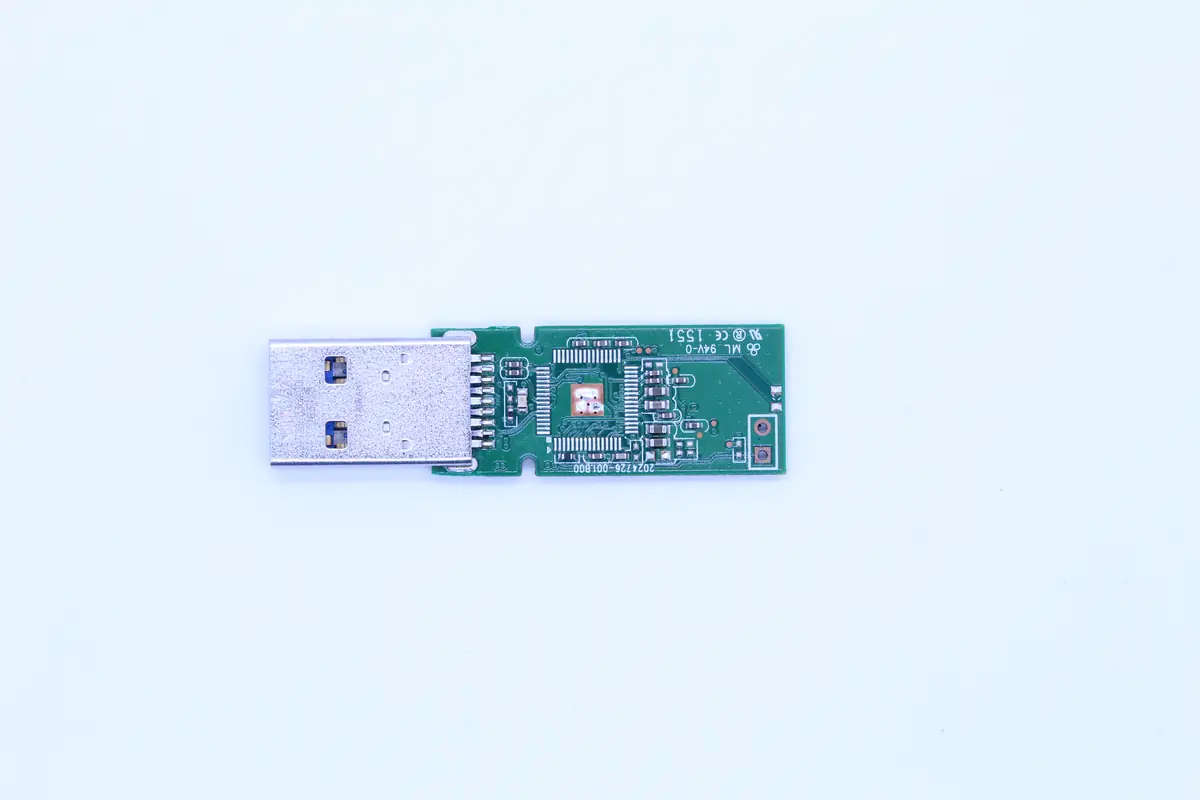
The Kingston DataTraveler Locker+ G3 is not a typical USB drive. Because of the hardware encryption (AES-256), it has a controller + eMMC memory chip combination, where the eMMC chip is integrated directly onto the PCB. This is a specific case:
- Standard USB drives have the NAND chip as a separate BGA component — it can be removed and read externally.
- eMMC modules combine NAND + control logic into a single chip — they can be read via an eMMC adapter.
- This Kingston has an eMMC module chemically bonded to the PCB (undermold) — standard desoldering does not work, the chip would be damaged.
Diagnosis: probably degradation of the memory cells in the eMMC. Current draw was elevated, the controller stalled during initialization. Because the drive is encrypted, even if we read block addresses in the controller, we would get encrypted data back without the key.
The client had the password. Good news — the data could be decrypted, provided we reached it.
The solution
Twenty-one days. One of the most demanding jobs of the past year.
- Day 1–3: Diagnostics, research into the DataTraveler Locker+ G3 architecture, searching for documentation and reference cases.
- Day 4–7: Removal of the PCB from the plastic casing, X-ray inspection of the exact placement of the eMMC chip. Found: undermold (chemically firm) + asymmetric microballs.
- Day 8–12: Custom procedure: chemical removal of the undermold. We used a specialized solvent (a professional preparation for forensic recovery) in a controlled temperature environment. 4 days for gradual dissolution, ongoing checks under the microscope.
- Day 13: Successful removal of the eMMC chip from the PCB. A critical moment — the temperature during the process must not exceed 80 °C, otherwise the NAND cells inside are destroyed.
- Day 14–15: Reballing the chip. Applying new microballs for connection to the eMMC adapter.
- Day 16–18: Reading the eMMC via a specialized adapter. A raw image of 32 GB of encrypted data was obtained.
- Day 19: Decryption using the client’s password. Kingston uses AES-256 with a key derived from the password + the chip’s hardware ID. Fortunately, we have software that can reconstruct the combination of these inputs.
- Day 20–21: Parsing the FAT32 file system, exporting the files, integrity check. 85 % of the files without errors, 10 % partially damaged (old records the client probably did not need), 5 % missing.
The result
- 85 % of the data recovered (about 17 GB of data out of 20 GB of occupied capacity)
- 21 days in total
- Three years of tax returns — fully recovered, all in order.
- Sole-trader accounting — fully recovered (invoices, income, expenses, contracts).
- Older documents (2021–2022) — some missing, the client remembered their content.
The client took the data on two new USB drives + cloud (Proton Drive for privacy). They left relieved — the tax-return period was approaching.
Lessons learned
For sole traders and small business owners who keep their accounting on a flash drive or external disk:
- No flash drive is your only copy. None whatsoever. Not even an encrypted one. Not even a more expensive one. Not even from a reputable brand. A single copy, never.
- Minimum scheme: flash drive + cloud. Set up Dropbox, Google Drive or Proton Drive. A copy of the accounting every week. It costs 5 minutes of your time and saves you dozens of hours of recovery.
- Forget paper backups — keep digital backups in the cloud. Cloud services do geographic replication. They have higher availability than your drawer.
- A law from 2023 requires digital archiving of certain sole-trader documents for up to 10 years. A single flash drive for 10 years is a gamble.
As for encrypted flash drives in general:
- Encryption is security against theft, not against hardware failure. These two things are often confused.
- For a sole trader’s level of security, a cloud with a strong password + 2FA is usually enough. Expensive encrypted flash drives are for those who work with sensitive client data (lawyers, healthcare professionals, auditors).
- If you insist on an encrypted flash drive, keep a backup in another form. Ideally on an encrypted local HDD + in the cloud.
PRO TIP
When a client comes in with „I’ve got three years of accounting on this and no copy," we know it’s a stressful situation. That’s why, for encrypted flash drives with a password the client knew, we have case studies with full 100 % recovery — this is a case where time and budget mean more than with family photos. Back up BEFORE the tax return comes due.
Have a similar case? Enquiry for USB flash recovery · +420 775 556 063