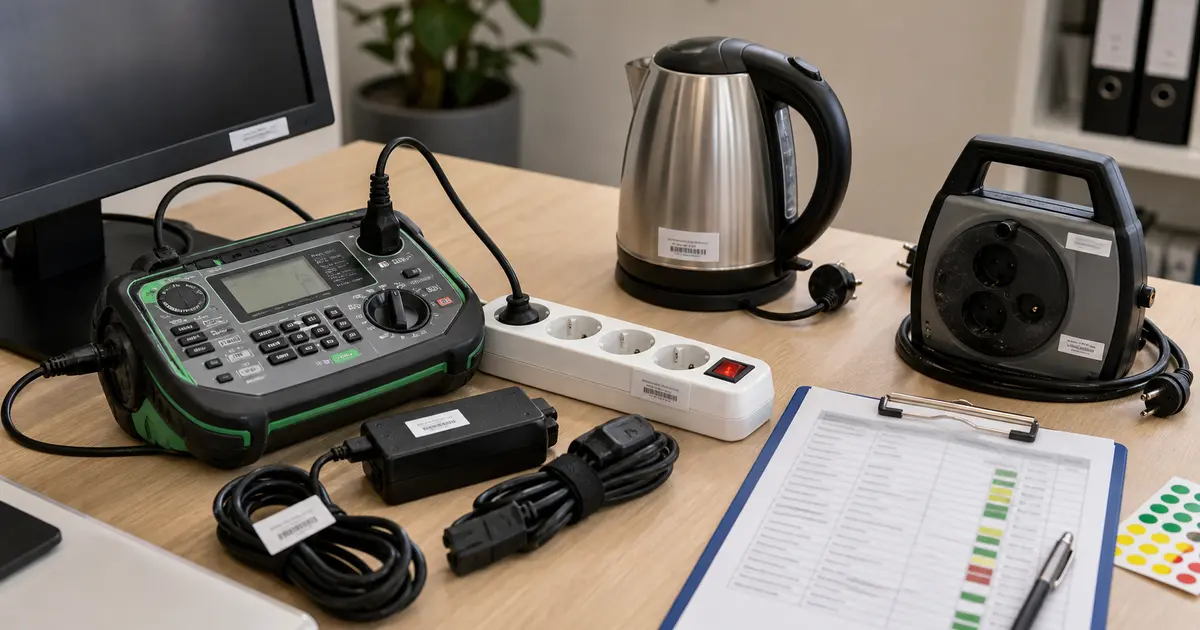
Quick answer: How often you must test electrical appliances in a company depends primarily on the usage group — an office is treated differently from a construction site or a production hall. As a rough guide, expect intervals of 12 to 24 months in offices, and more frequently than every six months in more demanding operations. The exact interval for a specific appliance is always determined by a test technician in accordance with the applicable standard ČSN 33 1600 ed. 2. Neglecting testing can result in fines from regional labour inspectorates, with an upper limit of up to CZK 2 million.
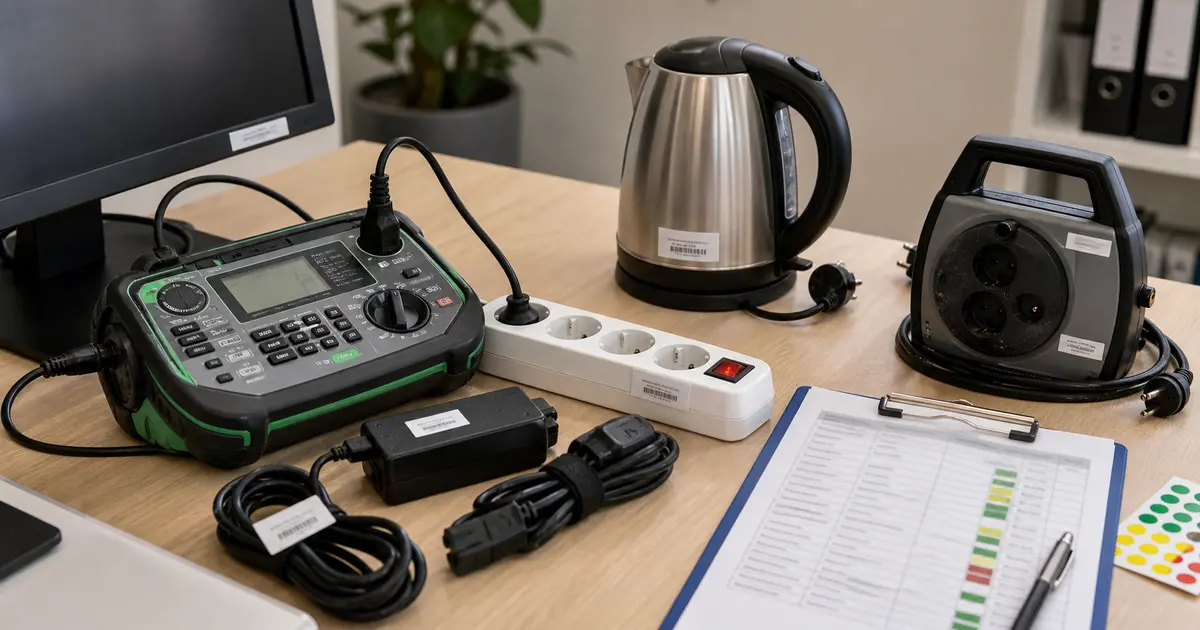
„How often do we have to test the kettle and laptops to remain compliant with regulations?" We hear this question constantly from managing directors, office managers, and operations staff at companies across Brno. Do not expect a single magic number as the answer. It involves a simple system that takes into account the environment, the manner of use, and the construction of the appliance — and you can grasp it in five minutes. Let us break it down without unnecessary regulatory jargon.
The fundamental classification that every operationally responsible person must know is based on distinguishing two frequently confused procedures. Before we get to the intervals themselves, let us clarify the terminology that determines who may perform the procedure and what documentation you will be left holding afterwards.
Inspection vs. testing: two different procedures
In practice, the words inspection and testing are used as synonyms, but technical standards draw a sharp line between them. An inspection consists of a visual check and a functional test of the appliance. It can be carried out by a so-called instructed person — typically your trained employee, who does not need to be a test technician. The result of an inspection is a finding as to whether the appliance works and shows no external signs of damage.
Testing is a considerably more thorough process — it includes a visual check, measurement, and a test, and, crucially, you receive a report for it. It is carried out exclusively by a test technician or an authorised person with the appropriate qualification. During testing, the appliance undergoes measurement of insulation resistance, protective conductor resistance, touch current testing, and other procedures according to the standard. It is the testing that yields a written report, which you present during an inspection.
Why do we emphasise this? Because the intervals that most concern companies are linked in the regulations specifically to testing, not to a simple inspection. And these intervals are derived from the system into which your appliance falls.
Five usage groups: where the appliance lives dictates the interval
Standard ČSN 33 1600 ed. 2 divides electrical appliances into five groups designated by the letters A to E. This is not about the technical specification of the appliance, but about the environment in which and the purpose for which you use it. One and the same device can thus be subject to different levels of stringency depending on whether it sits in an office or is used on a construction site.
| Group | Usage characteristic | Typical examples in your company |
|---|---|---|
| A | Appliances provided on a rental basis | Tool hire shop, equipment lent to clients |
| B | Outdoor use — construction, agriculture | Construction mixer, welder on site, pump in a field |
| C | Industrial and craft activities indoors | Workshop, production hall, joinery, press shop |
| D | Publicly accessible areas | School, hotel reception, restaurant, club, training room |
| E | Administrative activity | Offices, accounting department, open space |
A managing director or office manager will mostly deal with groups D and E. Group E includes all office equipment — computers, monitors, printers, kettles in the kitchenette, and chargers. However, if you have a training room attended by external participants, you are already in group D, which means a stricter regime. Operations staff at manufacturing companies primarily address group C, and, if they work on construction sites, also group B.
What else influences the interval
The usage group itself is only the first of three variables. To determine the exact testing interval, the test technician must also consider:
- Appliance type by handling method: handheld appliances (drill, soldering iron, hand lamp) are subject to the shortest intervals, followed by portable appliances (movable during use — laptop, vacuum cleaner, extension lead), with stationary appliances (fixed in place — server in a rack, large printer, wall-mounted water heater) typically having the longest intervals.
- Protection class: Class I appliances (with an earth pin, protection by earthing) and Class II appliances (double insulated, without an earth contact) are tested at different intervals; Class III (safety extra-low voltage) generally has the longest intervals.
- Intensity of use: if you use electrical tools for more than 250 operating hours per year, the standard requires more frequent testing than the basic interval.
Indicative interval ranges to work from: in offices (group E), testing is carried out approximately once every 12 to 24 months; in industrial operations and workshops (group C), once every 6 to 24 months, always depending on the specific type of appliance. A handheld appliance in an industrial setting may therefore require testing every six months, whereas a stationary device in the same environment may be tested once every two years.
The precise classification and resulting interval for each specific appliance is determined by the test technician according to Table 1 of the standard, specifically taking into account amendments Z1 and Z2. This system, however, gives you a reliable estimate and enables you to understand why intervals differ from one appliance to another within the company.
Beware of a common misconception: „The new standard means the whole thing no longer applies"
Misleading information circulates online claiming that ČSN 33 1600 ed. 2 has been withdrawn and replaced by European standards. This is not true — ČSN 33 1600 ed. 2 remains valid and in force. Since September 2021, two new European standards have been added alongside it: ČSN EN 50678 (concerning safety after repair) and ČSN EN 50699 (recurrent tests of appliances). Their mutual relationship with the original standard is governed by amendments Z1 and Z2.
In practice, this means they run concurrently — there are multiple ways to carry out testing, but the obligation to test electrical appliances in companies has certainly not disappeared as a result. If someone tells you otherwise, citing an allegedly withdrawn standard, verify the facts with a qualified test technician.
Fixed electrical installations are a different chapter
An important distinction that we often emphasise in consultations: appliance testing and fixed installation testing are two separate disciplines. Fixed installation testing — i.e., the wiring within the building, sockets, distribution boards, and fixed cable routes — is governed by standard ČSN 33 1500, Act No. 250/2021 Coll. on designated technical equipment, and the implementing government regulation No. 190/2022 Coll. We also handle this agenda for Brno-based companies; details can be found on the electrical testing Brno page.
What you risk by neglecting testing
Supervision of compliance with obligations relating to electrical appliance testing is carried out by regional labour inspectorates, colloquially „labour inspectorate" or OIP. The upper limit of a fine under Act No. 250/2021 Coll. reaches up to CZK 2 million. In practice, the sanctions imposed tend to be lower — often in the order of tens of thousands of crowns — but even these are not negligible.
The absence of testing has a far more serious impact in the event of an employee injury or property damage. In such a case, the insurance company will routinely investigate whether the prescribed testing was carried out. If it finds that it was not, it may reduce the payout or even refuse it entirely. The losses then fall on the company.
How smart companies handle it
A proven approach we observe in well-functioning Brno-based companies is built on three pillars: a unified register of intervals, automatic deadline monitoring, and one stable supplier. When testing, IT services, and health and safety are handled separately by three different companies, no one has a complete overview, and it is easy for an interval to be missed.
ITHOPE covers all these areas from a single source. We treat the testing of electrical appliances and tools, recurrent tests according to applicable standards, record-keeping, and monitoring of future deadlines as part of a comprehensive care package for your company’s operations. Add IT management and health and safety, and you eliminate the constant need to switch contacts between suppliers.
- Order testing: testing, health and safety, and training for companies
- Health and safety agenda: health and safety for companies
- Employee training: employee training
Frequently asked questions
Do laptops and chargers in the office also need to be tested?
Yes, these are appliances falling into group E (administrative activity) and intervals apply to them according to their type — a laptop is a portable appliance, as is a charger. The visual check and functional test can be carried out by an instructed person as part of inspections; testing with measurement and a report, however, is performed by a qualified technician.
Who is authorised to perform testing?
Electrical appliance testing may only be carried out by a person with appropriate qualifications according to Decree No. 194/2022 Coll. — typically a test technician or an authorised person who has passed the prescribed examination. An inspection (without measurement) can also be carried out by an employee you have trained.
What if the appliance belongs to an employee — such as their own kettle?
If a personal appliance is used on the employer’s premises, it enters the inspection and testing regime just like any other company device. We recommend establishing an internal policy that addresses the use of personal appliances and, ideally, limiting this practice to the necessary minimum.
How long does testing take at the company and what should be prepared for it?
The duration depends on the number and distribution of appliances. Before the technician arrives, prepare an up-to-date list of all electrical appliances, ensure free access to all devices, and gather any existing test reports, if available. Leave the rest to us — we will monitor the next test deadline and get in touch in good time.
We handle electrical testing in Brno and the surrounding areas so that you can handle your business. One supplier, one register, one point of contact. Send us a message or give us a call, and we will arrange a date that suits you, and we will take care of monitoring the next test ourselves.
Write to info@ithope.cz or call +420 774 777 774.
electrical testing Brno · testing, health and safety, and training · health and safety for companies
Where to find us
ITHOPE is a company based in Brno, Czechia: we do data recovery from disks, RAID and NAS, PC and laptop service and IT for business, all in our own lab at Viniční 3587/216, 615 00 Brno.
Phone +420 775 556 063 (24/7 line). You can bring the device in person, or send it by courier (Zásilkovna, PPL).