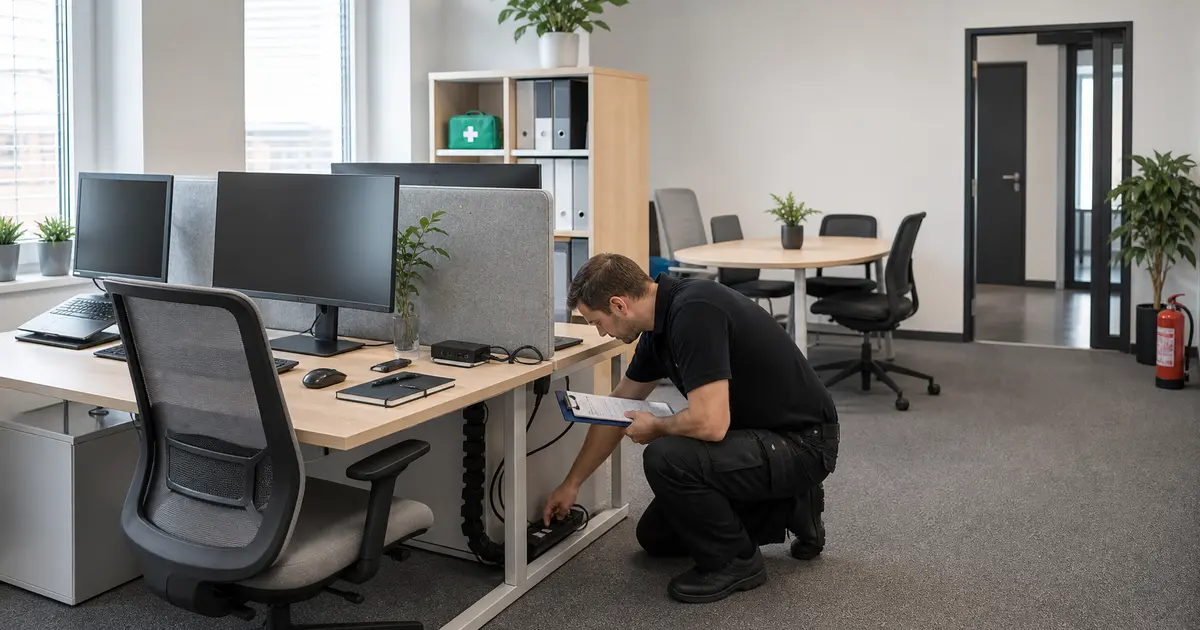
The short answer: Yes, health and safety legislation applies fully to purely office-based and IT companies; the duties are simply set at a level proportionate to the low risks involved. Below you will find eight specific areas that even a small office without a production floor must address. It is simpler for offices than for factories, but certainly not zero. The practical solution is a complete package from ITHOPE, combining documentation, training and inspections to save you time.
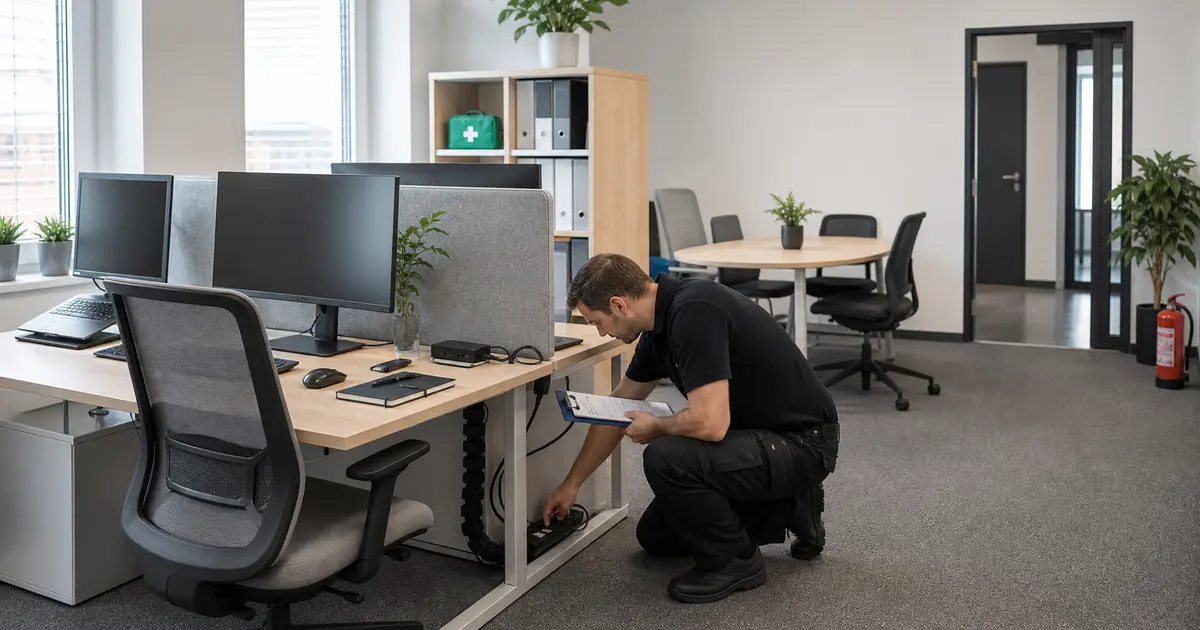
„We’re just an office, we don’t need to worry about H&S" – the costliest mistake made in peace and quiet
Among the directors and office managers of small companies, there is a prevailing notion that occupational health and safety is a topic for factories, construction sites or warehouses. An office with carpets, monitors and a coffee machine surely cannot be risky. This assumption has one flaw – the Czech Labour Code and the Act on Ensuring Additional Conditions of Safety and Health Protection at Work do not recognise any such exemption. The duties apply to every employer; only the scope and depth of measures depend on the specific risks present in the workplace.
The good news is that an office objectively has it simpler. No one is asking you for hard hats, scaffolding or soundproof walls. The bad news: you still need documentation, training, inspections and a contract with a medical practitioner. Moreover, during an inspection, the labour inspectorate does not ask whether you have a production floor – they are interested in whether you have employees. And if something is missing, the fine arrives just as quickly as it would for a workshop with hydraulic presses.
8 duties that an office-based company also has
The following list is not a complete enumeration of everything the law requires, but it covers eight areas that typically concern companies without a production floor – offices, IT companies, agencies, or e-shops run entirely from a desk.
1. Initial and periodic H&S training
Every employee must be trained on the safety rules and risks in their workplace before starting work. The employer manages periodic training through their own internal regulation – the law does not stipulate a fixed interval, but common practice is a frequency of once every one to two years. An attendance list and a record of the content are produced for each training session.
2. Job categorisation
Even seemingly risk-free administrative work must be assigned to one of the defined categories. Office positions typically fall into Category 1, where hygiene limits are not expected to be exceeded. You must have the categorisation in writing and send it to the regional public health authority. It is not a complex form, but it must be part of your documentation.
3. Risk assessment and documentation
The employer is obliged to seek, assess and evaluate risks in the workplace and to adopt measures to minimise them. The output is a written document describing the specific risks of your operation – tripping over a cable, a monitor falling, working with sharp objects such as a paper cutter – and a proposal for preventive steps. Without this piece of paper, you have no argument during an inspection.
4. Occupational medical services
Every company must have a contract with a provider of occupational medical services. This means an agreed clinic or doctor who carries out initial and periodic examinations of your employees. For Category 1, a periodic examination is due once every few years, but the contract and the system of examinations must exist at all times.
5. Electrical appliance inspections
An office full of computers, monitors, printers, chargers and electric kettles falls under what is known as Class E according to ČSN 33 1600 ed. 2. Appliance inspections are indicatively carried out once every 12 to 24 months – the exact interval depends on the environment and the manufacturer’s recommendation. Without valid inspection labels, you risk not only a fine but also a problem with your insurer in the event of a claim.
6. Fire safety
Under Act No. 133/1985 Coll., on Fire Protection, even a small office must be classified into a category of activities according to fire risk. The result is fire safety documentation (fire safety rules, evacuation plan), fire extinguishers in accessible locations, and regular checks of their functionality. Periodic fire safety training for employees is also part of the requirement.
7. Accident book
Even a minor injury, such as a paper cut, must be recorded. The accident book is kept physically or electronically, and every employee injury is recorded in it, regardless of whether it caused absence from work. It serves as a basis for any subsequent investigation and for injury statistics.
8. Ergonomics and work with display screen equipment
Government Regulation No. 361/2007 Coll., on the conditions of health protection at work, sets out the requirements for workplaces with monitors. The employer must ensure an ergonomic arrangement of the workstation – a height-adjustable chair, sufficient legroom, and appropriate positioning of the keyboard and monitor. This is not a cosmetic matter, but a directly enforceable duty.
Home office: responsibility does not end at the office door
Remote working does not mean the employer escapes their responsibility. Even with home office, the employer bears responsibility for H&S, albeit to an extent proportionate to the conditions. The company should have a written agreement specifying the basic rules for a safe home office environment – for example, adequate lighting, a suitable chair, or principles for handling company equipment. It is not necessary to carry out a physical inspection of the employee’s home, but demonstrably setting the framework conditions is the minimum the inspectorate expects.
Specifics of IT companies
IT companies – especially smaller ones – face several recurring pain points that merit a separate mention.
High concentration of appliances and chargers. Servers, switches, backup power supplies, laptops, phones, headsets – all of this requires regular Class E inspections. The more devices on a single socket circuit, the greater the reason to have your inspections in order.
Night shifts and on-call duties. Administrators and helpdesk staff often work in patterns that exceed the usual eight-hour office day. This brings specific requirements for rest periods and work regimes that must be reflected in the risk assessment.
Monitor ergonomics. Developers and testers spend tens of hours a week in front of screens. The correct setup of the workstation is all the more important here.
H&S „is owned by no one." In small companies without an HR department, the H&S agenda often remains in limbo. The owner deals with projects and the office manager handles invoices – who is responsible for inspections and training is usually only discovered when the inspector arrives.
How to solve this without an internal specialist
If you cannot afford a full-time safety technician and do not want H&S to hang on someone who lacks the capacity for it, there is a practical path: bundle everything into one package from someone who understands your operation.
ITHOPE is itself an IT company from Brno. We know office operations from the inside – no factories, no warehouses. Our services for offices cover what you actually need:
- Initial audit – we find out what you already have in order and what is missing, without unnecessary scaremongering.
- Complete H&S and fire safety documentation – risk assessment, categorisation, fire safety rules, training syllabi, all tailored to your operation.
- Employee training – both initial and periodic, clearly and without unnecessary theory on hazardous substances you will never see in an office.
- Electrical appliance inspections – we come, we label, we issue the reports. Everything on a single date, without negotiating with three different suppliers.
The result is a state where all your legal duties are covered, the audit trail is in order, and no one on your team has to spend evenings studying regulations.
Frequently asked questions
Does a three-person company need H&S documentation? Yes. The number of employees is irrelevant – the duties arise with the very first employee. The scope of documentation is adapted to a small operation and low risks, but it must exist. A three-person agency can manage with a briefer risk assessment than a corporate headquarters, but no document may be omitted entirely.
How often does H&S training need to be repeated? The interval for periodic training is determined by the employer themselves in an internal regulation. The law does not stipulate a fixed interval. In practice, office-based companies most commonly choose a period of once every one to two years. The important thing is to have the interval set in writing and to adhere to it.
Who can carry out H&S training? Training is carried out by a professionally qualified person, or – in simpler operations – by an authorised employee with sufficient knowledge and experience. For periodic training in an office, this could be, for example, a trained office manager. However, most companies prefer to entrust initial and more extensive training to an external specialist to ensure the content and format are correct.
Want to have your office H&S sorted without an internal specialist and without the uncertainty of missing something? Get in touch. We will review your current situation, propose the scope, and take care of everything from documentation to inspections.
ITHOPE – IT and H&S from Brno, we understand office-based companies.
Email info@ithope.cz or call +420 774 777 774.
H&S for companies · electrical inspections · electrical appliance inspection intervals · employee training · labour inspectorate inspection
Where to find us
ITHOPE is a company based in Brno, Czechia: we do data recovery from disks, RAID and NAS, PC and laptop service and IT for business, all in our own lab at Viniční 3587/216, 615 00 Brno.
Phone +420 775 556 063 (24/7 line). You can bring the device in person, or send it by courier (Zásilkovna, PPL).